Cette start-up française utilise la voix et l’intelligence artificielle générative pour évaluer, dans plusieurs pathologies psychiatriques, des symptômes spécifiques tels que l’anxiété ou le déclin...
Cette start-up française utilise la voix et l’intelligence artificielle générative pour évaluer, dans plusieurs pathologies psychiatriques, des symptômes spécifiques tels que l’anxiété ou le déclin cognitif. La société annonce un premier marquage CE fin janvier.
ESA and ClearSpace are launching PRELUDE, a mission to test autonomous satellite servicing and space debris removal, aiming to transform space operations by 2027.
Government hails step towards clean power in Great Britain by 2030 – but the auction shows trade-offs are now neededOffshore windfarm contracts to fuel 12m homes in Great Britain after record aucti...
Government hails step towards clean power in Great Britain by 2030 – but the auction shows trade-offs are now neededOffshore windfarm contracts to fuel 12m homes in Great Britain after record auctionEd Miliband: With this record wind power auction, we’ve proved the rightwing doubters wrongThe government has defied gloomy price expectations for its latest auction for offshore wind capacity. The worry a few months ago was that bill payers would be forced to pay more than £100 a megawatt hour (MWh) via contracts that give developers guaranteed prices for their electricity output. In the event, winning projects landed at roughly £91/MWh.Cue some forgivable crowing from Ed Miliband, the energy secretary. “A monumental step towards clean power by 2030,” he declared. Officials pointed to calculations by the energy consultants Aurora and Baringa that £94/MWh would have been a “cost-neutral” outcome for consumers even though today’s wholesale price, usually set by gas generation, is about £81/MWh (the analysts’ reasoning is that using less gas lowers the wholesale price, offsetting the cost of the subsidies for new windfarms). Continue reading...
Topics:
uk news
environment
energy
renewable energy
wind power
business
energy industry
science
For decades, astronomers believed that the most massive stars in the universe lived fast and died quietly, collapsing directly into black holes without the spectacular fireworks of a supernova expl...
For decades, astronomers believed that the most massive stars in the universe lived fast and died quietly, collapsing directly into black holes without the spectacular fireworks of a supernova explosion. That understanding has been dramatically overturned by observations of SN 2022esa, a peculiar supernova that erupted from an incomprehensibly massive star and is now destined to become a black hole binary system.
A nos lectrices et lecteurs... Par Mathieu Nowak, rédacteur en chef de Sciences et Avenir, Philippe Pajot, rédacteur en chef de La Recherche et Olivier Lascar, rédacteur en chef du digital.
For once, it was almost sunny, so I set off on my bike down Long Drove, camera in my backpack. Long Drove is a local country lane flanked by farmland, at least until you get to the dump and then to...
For once, it was almost sunny, so I set off on my bike down Long Drove, camera in my backpack. Long Drove is a local country lane flanked by farmland, at least until you get to the dump and then to one side is a vast, active, fetid tip. The air there is usually thick … Continue reading "Wings of the week – Red Kite"
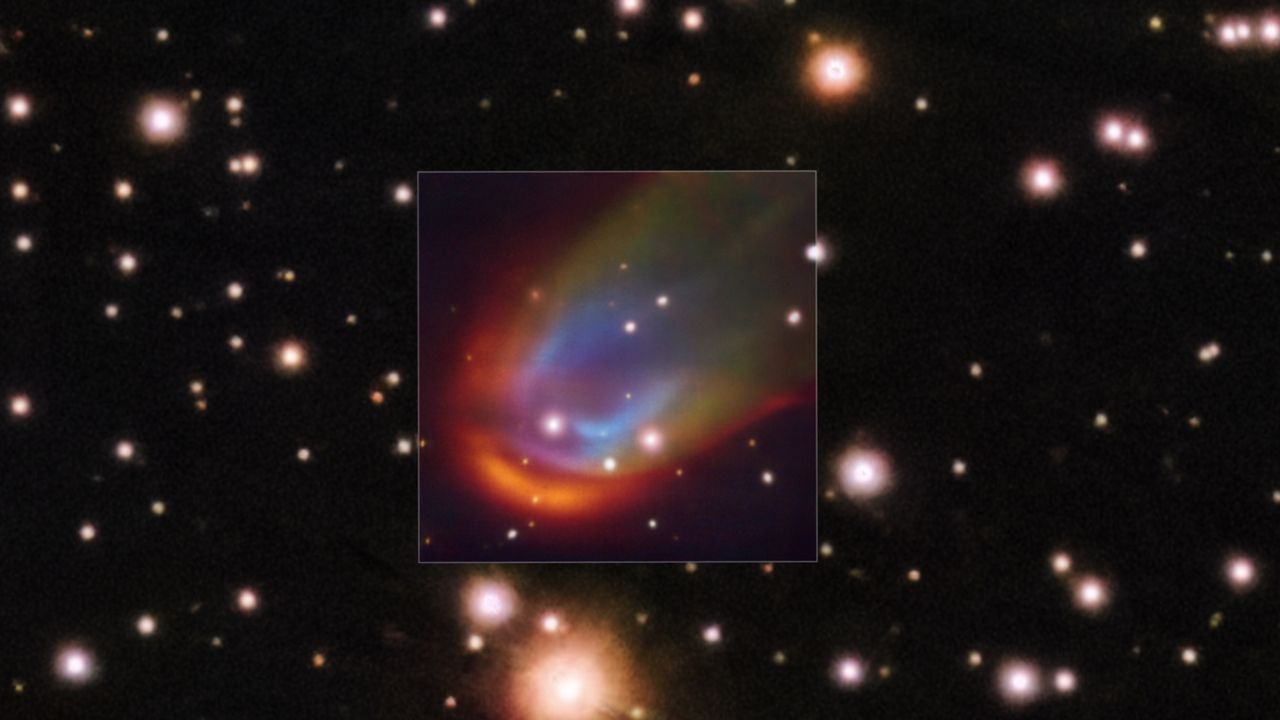
A new study reveals a rare-breaking white dwarf star, dubbed RXJ0528+2838, that is somehow generating a rainbow-like "bow shock" as it zooms through the Milky Way. The...
A new study reveals a rare-breaking white dwarf star, dubbed RXJ0528+2838, that is somehow generating a rainbow-like "bow shock" as it zooms through the Milky Way. The cosmic zombie is also ripping apart its partner star like a black hole.
The storing of the very first heritage cores in Antarctica marks a pivotal moment for the Ice Memory project launched in 2015 by CNRS, IRD, the University of Grenoble-Alpes (France), CNR, Ca' Fosca...
The storing of the very first heritage cores in Antarctica marks a pivotal moment for the Ice Memory project launched in 2015 by CNRS, IRD, the University of Grenoble-Alpes (France), CNR, Ca' Foscari University of Venice (Italy) and the Paul Scherrer Institute (Switzerland).